Golfers will try almost anything to gain a few extra yards. They invest in new drivers, schedule swing lessons, and experiment with different golf balls, shafts, and launch settings. Yet one of the most important pieces of performance equipment may already be inside their shoes—and it is often overlooked.
Factory golf shoe insoles are usually made from flat, soft foam designed primarily for basic cushioning. Under the rotational forces of a golf swing, that material can compress unevenly, allowing unwanted foot movement. Superfeet insoles take a different approach, combining structured support, a contoured shape, and a stabilizing heel cup to create a firmer connection between the golfer and the ground.
That distinction matters because the golf swing starts from the ground up. A golfer who can load, rotate, and push against a stable base may transfer force more efficiently through the legs, hips, torso, and club. Superfeet insoles are designed to improve that foundation without requiring a change in swing or additional physical effort.
Superfeet Sport Insoles Deliver Measurable Golf Performance
The most attention-grabbing case for Superfeet comes from independent research conducted through the Titleist Performance Institute. Testing of Superfeet Sport insoles measured meaningful improvements in several key performance categories:
- 11 additional yards of total drive distance
- 4 mph more clubhead speed
- 6 mph more ball speed
- 10 additional yards of carry
Individual results will naturally vary according to swing mechanics, physical condition, footwear and equipment. Still, the numbers illustrate why an insole should be viewed as more than a comfort accessory. If a golfer’s feet are more stable at address and throughout the swing, that improved connection with the ground may support faster, more efficient movement.
The current Superfeet Sport Support model is listed by the manufacturer as suitable for golf, tennis, pickleball and basketball. It combines resilient AeroSpring foam, a forefoot pad and an EVOLyte carbon-fiber-infused support cap. Superfeet says its contoured arch shape is designed to enhance foot biomechanics, while the structured cap creates a stable and connected feeling underfoot.
For golfers, that combination targets two demands at once: generating force during the swing and staying comfortable while walking the course.
Why Ground Force Matters in the Golf Swing
During the backswing, a golfer loads pressure into the trail side. During the transition and downswing, that pressure shifts toward the lead side as the player rotates and pushes against the ground. This sequence helps create clubhead speed, but it depends on the feet having a stable platform from which to work.
When a soft factory liner collapses under pressure, some of the golfer’s force can be absorbed by the material or lost through unwanted foot movement. It is similar to trying to make an explosive athletic move while standing on an unstable surface. The golfer may still produce speed, but the movement can become less efficient.
Superfeet insoles use a structured heel cup and stabilizer cap to help secure the rearfoot. Instead of simply adding more softness, the design supports the foot while allowing the player to push into the turf. A stable heel may help the golfer load more confidently into the trail side and move through the lead side with greater rotational leverage.
The goal is not to make the feet rigid. It is to give them a dependable platform so that the energy produced by the lower body has a cleaner path through the kinetic chain and into the club.
Managing Sway and Improving Contact
Excessive lateral sway is a common problem among recreational golfers. When the arch collapses or the foot rolls inward too aggressively, the ankle and knee can move out of position. That instability may travel upward, changing hip movement, posture and the location of the swing’s low point.
A properly matched Superfeet insole supports the natural shape of the arch and limits excessive motion without requiring the golfer to consciously manipulate the feet. With the heel sitting in a deeper, more stable cup, the lower body may feel quieter during the backswing and more controlled through impact.
That can have implications beyond speed. Better lower-body stability may help a golfer return the clubface to the ball more consistently. Even a small improvement in center-face contact can produce better ball speed, tighter dispersion and more predictable distance.
Superfeet insoles will not correct every swing fault, and they are not a substitute for instruction or properly fitted golf shoes. However, they may remove one source of instability that makes consistent movement more difficult.
Supporting the Entire Kinetic Chain
Foot position affects much more than the feet. If the rearfoot moves excessively or the ankle rolls inward, the knees and hips may shift as well. The body then has to compensate during fast rotation, which can add stress to the legs and lower back.
The contoured design of Superfeet insoles is intended to improve how the foot functions inside the shoe. By supporting the heel and arch, the insole can encourage better alignment through the ankles and knees. For golfers, that may produce a more balanced setup, a more controlled turn and a finish that feels easier to hold.
This does not mean an over-the-counter insole can diagnose or treat an injury. Golfers dealing with persistent foot, knee, hip or back pain should consult an appropriate healthcare professional. For players primarily seeking improved shoe fit, stability and support, however, Superfeet offers a practical equipment upgrade that works beneath the entire swing.
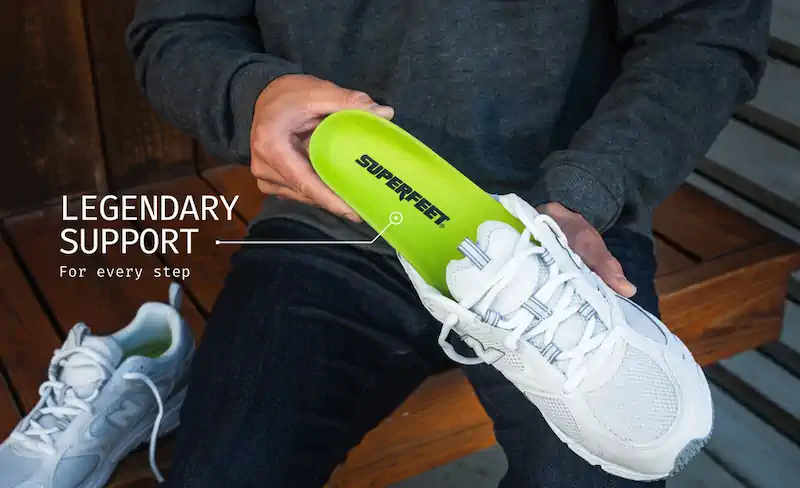
Superfeet insoles give golfers lasting comfort, reliable support and a more stable fit from the first tee to the final green.
Fresher Legs on the Back Nine
A typical walking round covers approximately four to six miles, often across slopes, sand, wet grass and uneven terrain. Even golfers who ride still spend hours standing, practicing, searching for balls and walking between carts, greens and tee boxes.
As the feet fatigue, the arches can begin to collapse and posture may become less athletic. Tired legs can also affect balance and tempo, contributing to the loose swings and missed shots that often appear late in a round.
Superfeet insoles help distribute pressure across the foot while providing structure under the heel and arch. The benefit is not simply that the shoe may feel more comfortable. By reducing the work feet must do to stabilize the body, supportive insoles may help preserve energy over 18 holes.
That could mean maintaining better posture on the 16th tee, making a more committed swing on the 17th approach and feeling less worn down after walking off the final green.
Choosing the Right Superfeet Insoles for Golf Shoes
Fit is essential because golf shoes vary dramatically in shape and interior volume. A supportive insole that is too thick can crowd the foot, while one that is too thin may not provide the desired feel.
Superfeet Green—now identified within the company’s all-purpose range as a high-arch support option—and Run Support, formerly called RUN Comfort, are better suited to standard or wider golf shoes with removable factory liners and enough interior depth. These models provide substantial structure and work best when the shoe has room to accommodate them.
Superfeet Blue, now represented by the company’s medium-arch all-purpose support category, has a lower-volume profile. It can be a better match for narrow, athletic or spikeless golf shoes where space is limited.
Golfers who prioritize a lightweight, responsive design should also consider a carbon-fiber-supported option. The Sport Support model uses an EVOLyte carbon-fiber-infused cap to provide structured support without unnecessary bulk. According to Superfeet, the model has maximum thickness and medium cushioning, so golfers should confirm that their shoes offer sufficient room before choosing it.
Most full-length Superfeet insoles replace the removable liner already inside the shoe. You can trim them using the original liner as a guide, and the company recommends leaving a small gap at the toe to prevent the insole from curling or bunching.
A Small Equipment Change With a Ground-Up Impact
Golfers often focus on improving the clubhead, but the body’s interaction with the ground deserves equal attention. Stable feet support better pressure movement, balance, and force transfer. They may also help a player maintain posture and energy across an entire round.
That is what makes Superfeet insoles especially interesting for golfers. They address both sides of on-course performance: the explosive rotational movement of the swing and the endurance required to play 18 holes.
Reported increases in clubhead speed, ball speed, carry, and total driving distance make Superfeet worth considering as a performance product. Just as important, their structured support may help golfers feel more secure inside their shoes from the opening tee shot to the final putt.
For players who have already optimized their clubs but still want to improve the way they interact with the turf, the next meaningful upgrade may not be in the golf bag. It may be directly under their feet.