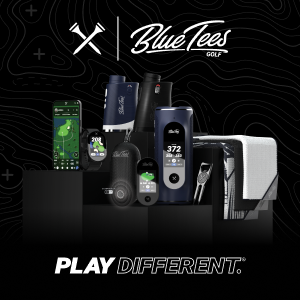
A Blue Tees Rangefinder combines the distance to the flag with information that helps put the shot in perspective. Captain Air and Captain Pro pair laser measurement and slope adjustment with GPS green distances through the Blue Tees Golf GAME app. Optional app features add adjusted yardages and club recommendations.
What interests me most is how those functions work together. The laser measures a specific target, while GPS shows the distances to the front, center, and back of the green. Knowing both can help a golfer choose a club, assess the available landing area, and decide whether the flag is worth attacking.
Captain Air and Captain Pro share the central connected features, but differ in display technology, magnification, controls, and protection. Those differences help determine which Blue Tees Rangefinder suits your priorities—and whether the Pro upgrade offers features you will use.
Why the Blue Tees Rangefinder Deserves Attention
Blue Tees Golf began with rangefinders and expanded into GPS devices, speakers, launch monitors, and software. Its focus on accessible golf technology has grown into a broader system that connects equipment with course information and performance data.
For me, the appeal of a Blue Tees Rangefinder is the combination of familiar operation and additional information. Both Captain models retain standalone laser ranging and slope adjustment without requiring an app, account, or subscription. Connecting to GAME then adds another layer of functionality.
That flexibility matters. A golfer can use the device for straightforward target measurement or incorporate course information and personalized guidance into the routine. The rangefinder remains useful even when the golfer does not need every software feature.
Both models also include practical conveniences such as magnetic mounting, USB-C charging, and vibration feedback during flag acquisition. These features have a clear purpose: keeping the device accessible, simplifying charging, and providing feedback when ranging a target.
Laser and GPS Give the Number Context
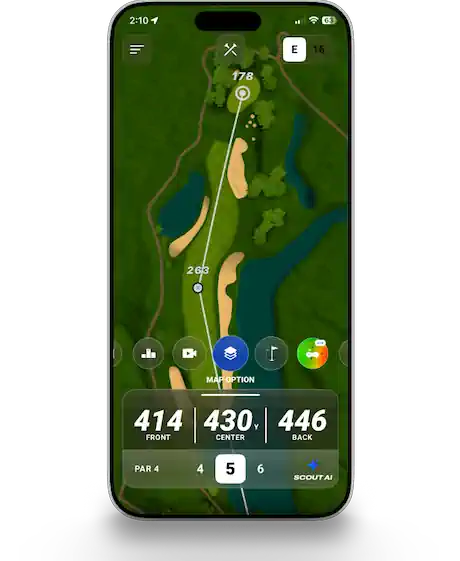
The GAME app combines a course map with front, center, and back green distances.
I value knowing how much green surrounds the flag. A laser reading alone does not tell a golfer whether the hole is near the front edge or tucked against the back.
Both Captain models can display front, center, and back GPS distances through GAME during a connected round. Those measurements complement the laser distance to the flag.
Consider a flag at 150 yards with the back edge at 155. A club that might carry 160 yards presents an obvious risk. Move the back edge to 175 yards, and the same flag distance leaves considerably more room.
That is where a connected Blue Tees Rangefinder becomes useful for course management. The information helps a golfer assess the target and the consequences of a miss. On an unfamiliar course, it can also provide context that would otherwise come from experience or a detailed yardage book.
Sometimes that information supports an aggressive shot. Sometimes it makes the case for aiming toward the center. Either way, the golfer has more to work with than a single number.
True Distance Helps Translate Yardage Into Club Selection
Slope adjustment accounts for an uphill or downhill shot. True Distance adds environmental factors, including wind, temperature, and altitude, to calculate a “plays-like” yardage. Both Captain models support the feature through GAME when the appropriate membership and settings are active.
I see the benefit as reducing the amount of mental adjustment between measuring the target and choosing a club. A level 150-yard shot in calm conditions can require a different decision from an uphill shot into the wind.
Club recommendations build on that process by matching the shot requirement with personal club-distance information. Golfers can adjust their yardages, while recorded performance helps inform the distance profile over time.
The golfer still makes the decision. Lie, trajectory, local gusts, and confidence with a particular club all matter. The technology’s useful role is to provide a better starting point.
Michael Novotny, Director of Software Product Management at Blue Tees Golf, described that purpose when introducing GAME’s Intelligence tier: “The biggest challenge in golf isn’t collecting data. It’s understanding what to do with it.”
That distinction is important. More information becomes valuable when it helps explain a decision or identifies something a golfer can improve.
Connecting to GAME Adds a Step
Connecting a Blue Tees Rangefinder to GAME makes the course information part of the ranging routine. Pair the device inside the app, register it, and start a round to access connected green distances. Slope must be enabled for connected information to appear on the rangefinder.
GAME also supports compatible Blue Tees GPS speakers, watches, and handheld devices, giving golfers several ways to access on-course information through the same platform. Depending on membership, it adds scorekeeping, course maps, club recommendations, and post-round analysis.
The free Lite plan includes front, center, and back GPS distances. Core costs $49.99 annually and adds True Distance, club recommendations, scorecards, and green heat maps. Intelligence costs $79.99 annually after its introductory trial and adds Scout AI, satellite maps, and broader analysis. Subscriptions renew annually.
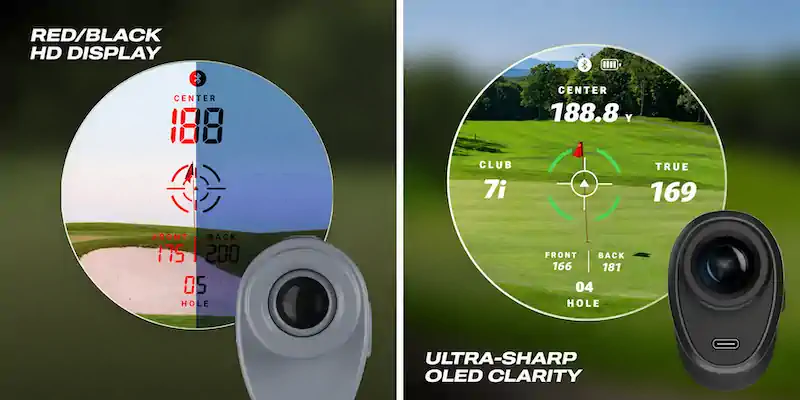
Captain Air (left) features a red-and-black HD LCD display, while Captain Pro (right) uses a multi-color OLED display with adjustable brightness. Both support GPS green distances and optional GAME app guidance.
Captain Air: Choose It for Essential Features and Lower Cost
The Captain Air brings the core Blue Tees Rangefinder experience to golfers for about $250. It combines 6X magnification with a red-and-black HD LCD display and a maximum measurement range of 1,000 yards. Flag-lock vibration provides feedback during target acquisition, while a physical slope switch turns slope compensation on or off.
Practical features include a magnetic mount, USB-C rechargeable battery, IP65 protection, and an included carrying case and charging cable. Connecting to GAME adds GPS green distances and access to optional app-powered guidance. Find My Rangefinder lets golfers check the device’s last known location.
Captain Air is the better choice for golfers who want laser ranging, slope adjustment, and GAME connectivity at a lower purchase price. Its suitability comes down to feature preferences rather than handicap: golfers comfortable with 6X magnification and an LCD display may have little reason to choose the Pro upgrade.
Captain Pro: Choose the Upgrade for Display and Control
The Captain Pro builds on the Blue Tees Rangefinder experience for about $300, pairing 7X magnification with a multi-color OLED display and four adjustable brightness settings. Flag-lock vibration provides feedback during target acquisition.
Its maximum measurement range is 1,200 yards, compared with Captain Air’s 1,000 yards. These figures describe maximum ranging capability, not guaranteed flag-lock distances. For most approach shots, I would weigh display readability, magnification, and controls more than the extra range.
You can configure a programmable LED Action Button through GAME for functions such as brightness adjustment and slope control. Practical features include a magnetic mount, USB-C rechargeable battery, IP67 protection, and an included carrying case and charging cable. GAME connectivity adds GPS green distances and access to optional app-powered guidance, while Find My Rangefinder lets golfers check the device’s last known location.
Captain Pro is the better choice for golfers who prioritize OLED display technology, greater magnification, and customizable controls. Those features are the strongest reasons to upgrade, especially for frequent players. The higher protection rating is another consideration for golfers who regularly play in wet conditions.
Which Blue Tees Rangefinder Should You Choose?
Choose Captain Air if you want laser ranging, slope adjustment, and connected GPS for about $250. Its 6X magnification, LCD display, and physical slope switch cover the core functions without the extra cost of hardware you may not need.
Choose the Captain Pro upgrade if an OLED display, 7X magnification, programmable controls, and IP67 protection matter to you. At about $300, its strongest advantages are the viewing experience and customization. I would weigh those differences more than its longer maximum range.
For either Blue Tees Rangefinder, choose the GAME membership based on how you will use it. The free Lite tier provides GPS green distances. Core adds True Distance and club recommendations, while Intelligence offers broader course visualization and performance analysis.
The Pro upgrade is primarily about display, controls, and protection; both models provide access to GAME’s central connected features.